


Download a PDF version of this document
Contact me by e-mail me if you would like permission to share or use this document.

Many of us have fond memories of beginning this hobby as young kids. Our imaginations were fuelled by the excitement of controlling armies of small figures, which were then fuelled by loving parents and allowances. I'm sure some parents might look on these type of games with concern or at least confusion, since they can be harder to relate to, which is what I'd like to address in this post.
Overall, the hobby is a very positive one. The negative things I'll touch on here aren't meant as a critique of what it is wargames are about - just that parents deserve to know all the facts about what their kids are in to.
The introduction to wargaming usually happens through a friend or while browsing a hobby or comic shop. Figures are eye-catching and line walls in boxes with exciting artwork or sit finely painted in display cabinets. (Painting is part of the hobby) They'd be small, usually no taller than a few inches, surrounded by larger things like tanks or beasts.
There are many genres of miniature wargaming, all with their own rules; science fiction, fantasy and historical (Civil or World War) being the most common, but there are other companies creating other games with steam punk, horror or victorian themes.
Wargaming is:
- A large scale board game
- Using armies of miniature figures instead of pieces.
- That move with tape measures instead of squares on a board.
- Dice still determine the outcome of battles.
- You battle opponents to complete a mission
- Wipe out the enemy, kill their commander, capture a building, etc.
- To shorten games, some are played for a number of turns and points determine the outcome.
- Games are usually played in a 4' x 4' area.
- Dining / kitchen tables are usually large enough.
- Adding terrain like houses, hills and trees add flair to battles.
No doubt, parents will have questions and concerns about whether a game is age-appropriate for their children. I'm going to answer some questions, but ultimately it's up to you if you think this is an appropriate hobby for your own children.
While researching, I asked around to get feedback from different gaming communities. My "thank yous" are at the end of the article, but I was glad to see that for the most part people from multiple groups had similar opinions.
For the record, my parents had this to say:
"In all the 20-odd years of your war gaming hobby we were never concerned...just curious as to the intricacy of the game. It allowed you to develop fine motor skills, patience, an ability to interact with people of various ages ( those store employees who were helpful and who welcomed newbies) The hobby was put on the backburner during a few of those years, but as you've proved, can be picked up again. Like any hobby the skill level can increase to the time spent."
All things in moderation
Even with the best of things, too much can be bad. If your kids school work or other responsibilities are being impacted, it's not the fault of the game. Any hobby like watching TV, playing video games, card or board games and even sports can distract kids from their responsibilities. If it becomes a problem, limit their time.
What's the difference between "Wargames" and "Roleplaying Games"?
Lots. While roleplaying games are using miniatures these days, wargames are very different.
In roleplaying, (Like Dungeons and Dragons) players take the role of a single character in a fantasy world; gaining experience, levelling up and amassing riches and power. Games are played from the perspective of the character, acting out things and talking to each other as if they were their characters. Since there is no "end" or "winners" in roleplaying games, things are more cooperative but players become attached to their characters - having a character die would be comparable to them losing a save file in their favourite video game. It sucks.
Wargaming is more like really fancy chess. Players control an army and every game has an end. There's no roleplaying to it, you don't put yourselves in your troops' shoes, no acting things out - it's just moving figures around on a tabletop. Like any sport, there are winners and losers.
What age is a reasonable time to start the hobby?
 |
| via |
A lot of people start in their mid-teens... At this age, kids understand rules easier, can handle assembling figures and will have an easier time finding people to play against. Since they're starting to find their independence, some of these questions may not apply, but you're probably still interested. At younger ages, lots of rules can be confusing, disagreements more tense and losses can be rougher on the ego.
I was about 11 or 12 when I started playing, my brother being two years younger. He didn't really get into it, but I recall him having a rough grasp of the rules if not tactics.
How does the complexity compare to games I'm used to?
 |
| via |
Most hobby stores will show people how the games are played, and this is a good way to see if your kids can understand the system before spending money.
Can girls play?
 |
| via |
Plenty of girls and women gaming these days (Including my Wife.) and they're not limited to "girly" armies. Game systems like the ones from Privateer Press (Hordes / Warmachine) make more of a point to include heroines and female troops.
However, wargaming used to be considered a "boy" hobby, and the player base is still primarily male. The chances of finding a girl at the local gaming store are slim and many players are guys in their 20's, 30's and older. Parents may not be comfortable with their daughters in that situation. That said, kids don't have to play at the store - you can set them up on a table at home and let them game with friends or spend time at the store with a book while your kids play.
Are many kids wargaming?
Will this affect them socially?
 |
| via |
Odds are that they won't find players their age at the hobby store either. Kids may be better off playing with friends their own age, as they're not going to make the same connection to older gamers they'll meet through your local store. They might get along well enough, but teens and adults probably won't be inviting kids along to other social events outside of wargaming. (And you probably don't want them to.)
For many kids who are into "geek" hobbies, wargaming is an excellent one that requires a bunch of social interaction. Whether playing kids their own age, or people at a store, this can be something that encourages your child to put down the video games and make friends outside of the internet.
How big are these models and armies?
 |
| via |
Depending on the game system, an army might have anywhere from 5-20 models (small) to 20-40 models (medium) or even over 100 models. To balance, some armies are designed as a small group of very powerful soldiers, large swarms of weaker troops and all sorts of things in between.
How much is this going to cost?
Well, it's certainly more expensive than a board game. But, it's no more expensive than buying a game console, computer, a bunch of video games, equipment for a kid who plays sports, an instrument and music lessons or just about any other hobby these days.
 |
| via |
There's a little more beyond just the models.. You might be looking at $50 - $100 in hobby expenses like glue, snips, paint and brushes. These are necessary to assemble and paint the figures, but it's also an extremely positive part of the hobby. Aside from the glue and maybe snips, the others can be bought after your decide if it's something they want to stick with.
After playing the basic game, your kids will want to increase the size of their army, something that IS affordable on an allowance or a part-time job. Models can be bought for around $10-20 or they can save up for squads, tanks, machines and beasts at around $40-60 each. They can also buy more paint and replace brushes as required. This is trickier as a gift, because you won't know what models they want - gift cards or a wishlist are a good option.
Can we buy used models?
That you can! eBay is a great place to start or local sites like Kijiji and Craigs List. Hobby shops or local players may sell used miniatures too. Miniatures tend to sell used MUCH cheaper than they were originally bought for. (Unless painted expertly) The down side of buying used is that they're usually already glued together and painted. You might have to help them cut models apart and strip paint off.
Do the rules change and do updates have to be purchased?
Games are constantly being revised to improve the rules and, to be honest, sell more models. Every 3 years or so, you can expect a new rulebook to be released, ($30-50) as well as new rule books for each of the armies. Sometimes there will also be expansion packs add a new aspect.
Worth asking shop owners, is "When is the next edition expected?" It's unfortunate, but sometimes people buy a bunch of rulebooks that get replaced a few months later. New rules are totally optional though and old models are still usable.
From time to time, free updates called FAQ's (Frequently Asked Questions) are released online. These clarify confusions people have over how things are supposed to work.
What if they lose interest in the game?
Kids do that. Considering the long-term cost of this hobby, ask yourself how many interests have your kids picked up and then chosen something else? If you hold off on buying it right away and they keep asking about it instead of forgetting, then maybe it's something they are interested in.
If they're interested, get them the basic set and let them play before investing more. If they lose interest, then it's as if you bought a board game. Or let them spend their own money and if they change their minds, that's part of growing up and learning to spend money.
If they want to quit, try to find out why. Perhaps they need moral support because they don't like losing. It could be that the rules are too complicated and they need help learning. Maybe they just don't enjoy it. If they do quit, models will only sell used for a fraction of what they're worth - you could always pack things up until they're older.
How much time and/or effort will I have to put in?
 |
| via |
A good battlefield will have terrain on it to make it look real and instead of buying a bunch, you could build small dioramas: houses, hills, forests, fences, facilities, etc. If you're artistic, you could help them learn to paint.
Sometimes you might have to read rules to help where there's a rule that don't make sense. You might also find yourself killing hours at hobby stores while they play a game or two if you're not comfortable leaving them alone.
How long do games take?
Depending on the game system, small battles can take an hour or two, while larger ones could take a portion of the day. (Comparable to a sports game.) If they're using your dining room table, this can get in the way when it's time to finish the game and clean up for dinner. Begging to leave a battle setup overnight and finish it off another day isn't unheard of either.
How much space will this take up?

A dining room table can be used to play on, or folding tables can be bought from office supply stores. A four foot square table is a good size to play on, or 4' x 8' for 4+ players. If they start building terrain like forests and buildings, a couple medium sized boxes might be needed so there's somewhere to put everything. Books, pots, lego, old computer parts and anything else from around the house (that isn't breakable) can be used instead of terrain.
The benefit to giving them somewhere to hobby, is the activities are at least somewhat supervised even if you're not playing with them. Hobby stores often make tables available for customers to use as well.
How many people can play at once?
Usually these are games for 1 vs 1. We usually played games of 2 vs 2 and that always worked out fine. Larger games could mean a larger table and mean more room for everyone playing though. A large table can also be split in half to allow multiple games at once. These games are designed for 1 vs 1 though - more people can slow down the pacing and it gets less exciting.
Do they have to buy all the models? Paint them?
While figuring out which model they want to buy some people will use lego, army men or paper cut outs on stands. This is acceptable for short periods of time, but in the long run the real models should be bought. Sometimes developers make rules for models that aren't being sold yet - in this case, it's acceptable to represent models or create your own using parts from multiple ones as long as they're roughly the right size.
Painting is optional, but models really look better with. Aside from some tournaments which might require a minimum amount (usually 3 colours), there's nothing saying they have to be painted to be played with.
Are there easier wargames available?
Yes, there are.
Some bridge the gap between what you're used to in a "board game" and what might excite your kids in a "wargame." These are MUCH easier to learn, tend to be a lot cheaper and are still paintable. These also might be something easier for you to relate to your kids with and get involved in.
 |
| Lego Heroica |
Employees of a hobby store can point you in the direction of current options like Super Dungeon Explore, "Clix" and even Star Wars / Trek space battles.
They're usually still competitive games, so you might have to go easy on your kids. What's neat about some of these is that you could play the monsters, and your children the heroes.
If you're familiar with the rules, you could even try to simplify them. It's not unheard of for some developers to include "basic" and "complete" rules.
As for cost, these easier systems are usually in the $30-50 range and are self contained aside from an optional expansion pack.
Are there cooperative wargames?
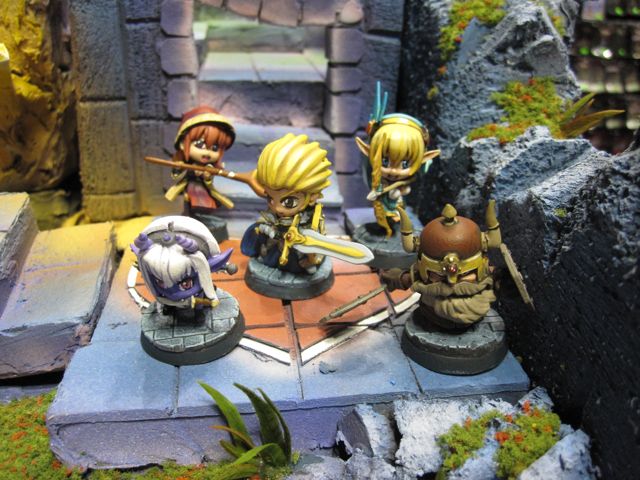 |
| via |
There are cooperative aspects, such as playing in teams while planning strategies together and using armies that compensate for the weaknesses of each others. However, they still need human opponents to play against. There really aren't any totally co-op wargames out there.
Super Dungeon Explore is a current game that is less competitive and more about a group of friends playing adventurers, hacking at monsters in a dungeon run by another friend. Kids can take turns playing the monsters.
Are there ways to balance things out if someone's a lot better at these games than their peers?
Because these are point based systems, you could give someone more or less points. Be careful how much, because a few points can make a big difference. I recommend percentage because each game has a different point system. Privateer Press games are usually 35 or 50 points while Warhammer 40k games might be 500 - 2000 points. 5-10% bumps are safer as you want to make it more challenging without the stronger player thinking they're being punished for understanding the game better.
To help the weaker player, they could be given a copy of their opponent's army list ahead of time so they can plan ahead.
Unfortunately, the reality is that losing is part of the game and hopefully the underdog learns from their mistakes and becomes a better player.
How are disagreements over rules resolved?
Even adults get into arguments over a rule that's unclear, so you can bet kids will too. Rule of thumb is to roll a die to determine how to use the rule for the rest of the game and look in to it later.
A game store can help to mediate rule issues, so a phone call can be a quick solution. Game devs are often releasing "Frequency Asked Questions" and "Errata" documents on their websites to clear up many of the questions they receive - but you can also email them.
As an adult, you may have to read the rules and help interpret them. If you do, you'll need to read ALL the rules because these books aren't always laid out the best and a rule might not be clear without understanding multiple sections.
What skills can be learned from this hobby?
There are plenty of positive things that kids can learn from wargaming. Painting, critical thinking, socializing, cooperating and even budgeting only touch on the intricacies that players learn.
Painting leads to creativity, fine motor skills, concentration, etc. Most stores don't have classes, but there are instructional books / DVDs and plenty of online resources. YouTube is GREAT for this.
Minds become more analytical as they figure out what minis they want to use in the game and how to use them to complete each mission's objective. During games, they'll begin to get good at estimating distances, math, chance and more critical thinking.
If they're buying figures with their own money, prioritizing miniatures vs their cost and saving up for larger models becomes important. Maybe it'll even be a reason for them to get a part-time job.
What kind of language and imagery are there in these games?
 |
| via |
There's virtually no nudity in wargaming - BUT, Games Workshop, while marketing their games to younger audiences, has released semi-nude sculpts in the past. The miniature painting hobby also extends past gaming, and some professional sculptures may release nude or semi-nude figures - not something you run across in stores but could be found online if they're looking for other miniatures to paint.
Language is usually safe; avoiding cursing, slurs and other offensive words. That doesn't mean that other players won't cross those lines - playing at a hobby store could mean a little foul language even though stores will often encourage players to be PG.
Reading novels based on these systems or browsing the internet could expose your kids to stronger language or graphic images.
Are there any other negative themes within wargames?
War, and war-heroes are often celebrated topics, as can be the glorification of war to solve conflicts and diplomacy is rarely mentioned unless someone's going to get stabbed in the back. The flip side is all systems usually portray the devastation war brings. There is great debate about whether games about war trivialize what real people live through or if they make kids aware of impact war has.
Some armies have been stylized as extreme parodies taken from our history - brutal Mongolian ogres, communists in heavy armour, righteous orders of paladins, savage Trolls driven from their lands and even fascist / xenophobic regimes. Other armies have been created in the image of "evil" such as ghosts, goblins, orcs, dragons, beasts and yes, cultists or demons. Obviously the game doesn't involve devil worship, but some parents might not be comfortable if their child came home eager to command an army of demons. The same goes for the depiction of religion-based armies, who are often portrayed as crazed witch-burning zealots, instead of a positive light.
 |
| via |
Miniatures do tend to be lacking in gender and racial diversity. Some developers are beginning to include women in normal armies while others (Again, Games Workshop) write that their most popular armies can't include women at all so they segregate them to poorly supported women only "Sisters of Battle" armies. Most developers still portray women as busty and scantily clad. (Nothing worse than mainstream media) Human figures also don't tend to get painted with skin tones other than white or tan, except for stereotypical theme armies such as African jungle fighters or middle-eastern desert fighters. Of course, nothing stops you from modifying or painting your troops however you'd like.
Children can easily misinterpret these topics. It's always a good idea to talk to your kids about any issues you're concerned about. Some kids are sensitive to these issues - If they can't handle violence in the media, they might have trouble with these games.
Some of the game systems also publish novels based on their games. These tend to be more detailed than the fluff in rule books. Questionable themes could be glorified and exaggerated to higher levels and kids could become more influenced by the setting as they read.
Are there any game systems with child-friendly themes?
 |
| via |
Some systems approach the topic from different angles. Super Dungeon Explore has a very cartoonish style, Wyrd Miniatures battles (creepy) puppets and Battletech has giant robots driven by human pilots.
The two most common brands today are Hordes or Warmachine from Privateer Press and Warhammer Fantasy or Warhammer 40,000 from Games Workshop. GW's one of the longest running miniature companies with possibly the biggest player group - they're also the darkest. (Known as "grim-dark") Their settings are intensely violent and dark and often based off the worst parts of our real life history. Privateer Press' lines are still about war-torn lands and include some dark armies, but their fiction doesn't go out of it's way to be so violent, and they do include a fair amount of strong female characters and infantry.
Am I being too sensitive to these issues?
This is a pretty subjective topic and depends on how mature your kids are. It's a parents right to control what their kids are subjected to, which is why it's important you're aware of the hobbies they're interested in. Recognizing the difference between fantasy and reality is important. This is a game after all, and if your kids recognize it, then what's the harm of pretending?
 |
| via |
In reality, stereotypes game developers play on are similar to what mainstream media portrays. Between news, movies, tv, video games, comics and even schools, kids are already getting the idea that war is a necessary and patriotic duty. Some topics mentioned are questionable though, especially for younger kids who have trouble understanding the difference between real and make belief, which is why you're asking these questions.
If you want more information, pick up the rulebooks and read "fluff" - the sections (usually at the beginning of the books) that tell stories about the background of the armies and worlds, instead of rules. Or talk to the employees at the hobby shop.
How competitive are these games?
These games should be played for fun, but people can get pretty competitive about any game that has winners and losers. Store will often run tournaments requiring people to bring their "A Game" and probably aren't the place for kids with a looser grasp of the rules. It's unfortunately, but even cheating or "convenient forgetfulness" isn't unheard of.
Ideally, friends can spend a few hours gaming or painting while joking, snacking, and enjoying themselves.
Will my kids get discouraged?
Moral support may be required as kids tend to have a weaker grasp on the idea that losing and trying again is part of the learning process. Playing against seasoned players at hobby stores can lead to particularly brutal losses which can place a bigger strain on the ego. When kids lose a bunch, their first reaction can be to quit. They may need help looking at what went wrong in a game, or creating tactics and lists. Sometimes a list they enjoy playing just doesn't work against what their opponent is doing, or they play it so often their opponent can predict what they'll do.
The same goes with their painting ability. Seeing professionally painted models can make their own look terrible in contrast. As with all things, it's part of the learning process.
You're the one who'll know best how your kids will react.
Where are hobby stores located?
Sometimes malls, but typically in lower rent areas or downtown. Not to say the "bad parts of town" but maybe not the nicest places either. This could factor in to your decision of whether you're comfortable leaving them there by themselves.
Should I leave my kids at these stores?
This is completely up to you, the maturity of your kids and the store. Some are perfectly willing to show kids how to play the games and let them play their armies on decorated tabletops full of beautiful scenery. The idea is you'll start spending money at their store, and your kids will end up buying their own models. But they're not babysitters and a store run by a single employee can't be expected to watch your kids or keep them in line if they cause a disturbance. Talk to an employee or manager and see if they're comfortable with you leaving your kids there and leave contact information - also be understanding if they're not OK with you leaving your children unsupervised.
 |
| via |
If you're not comfortable leaving them alone, then stay. Get involved with their games, bring a book or other distraction and see if the store has a chair available to you. They're a business like any other, and if giving you a space where you can keep yourself busy for a few hours means you'll bring your kids and their friends back to spend money, then they'll probably accommodate you.
Who are the people that play at these stores?
This REALLY varies from place to place. They don't tend to be jocks or cheerleader types, and yes are often "geeks" or "nerds". But these are generally good people just like you'd find in any other social circle. A wide range of people wargame, most of them have jobs, often in respectable careers, many have families and friends of their own and are perfectly fine for your kids to be around. They're generally friendly people, who are quite accepting of people from any background.
However, like any social circle, there may be people who aren't the greatest of role models. If you feel like leaving your kids at these stores, you might want to spend some time with them first.
Are there places for me to learn more about these games?
Lot of resources are online. There are videos on YouTube, websites full of news, and plenty of bloggers discussion different aspects like list building, tactics and painting. Store owners are also usually willing to discuss the games too but I've run in to a few who'd be more likely to sell you product than suggest your child is too young to play.
Can the hobby side be dangerous or messy?
What are their alternatives?
 |
| via |
Plastic glue, while a chemical, won't hurt or stick skin together. Super glue, for metal, CAN stick fingers together, or models to fingers. As long as your kid doesn't panic and do something like try to use a knife or pry it off, they'll be fine and it'll come apart. Clean it, rub it, gently pull the fingers apart.. maybe gently file it... or take them to a doctor.
Paint for these systems are usually acrylic, meaning water based, and in small containers. Water is used for cleaning brushes, not paint thinner, and spills won't make a large mess. Carpets could be stained, but you can buy one of those plastic office mats to go on the floor where they'll be painting and lay newspaper on the table they're painting at.
Models need to be primed with spray paint, which you might have to help with. Do it outside in warm weather and lay down newspaper or garbage bags to prevent spraying the floor. Primer isn't water based, but will wash off with soap and water.
If you need to strip paint from miniatures, there are environmentally friendly options like Simple Green that strip paint excellently. (Instead of paint thinner, which can melt plastic models)
I also want to thank the people who helped me compile this list:
TheWife, my parents and friends Jim and Dan.
Loquacious from the blogosphere.
Moe, SirKently, Rockwater, Agent Purple from The Chosen Realms and Windsor Gaming Resource, my local gaming buddies.
Khornate, Kris Knives, Ashran, Korsarro-Khan, IGFanatic, Fneuch, BunkhouseBuster, stickmaster97 at the always awesome MiniWarGaming Forum.

Ganesha's A Song of Blades and Heroes and its spinoffs should be quite good for kids. Also, Brikwars.
ReplyDeleteGames like Warmachine and Malifaux are simply too complicated.
One could look into Brushfire and Warheads for games that have cutesy figures. Using 28mm prepainted figures is also an option.
I'll look in to the two you mention, but I'd still argue it depends on the maturity of the kid whether or not something's too complicated.
ReplyDeleteGood stuff. I do think 'female heroine' is somewhat redundant though. :p
ReplyDeleteLol, thanks Von, corrected ;)
ReplyDeleteI will get back to this later. I have LOTS to say about it.
ReplyDeleteI'm looking forward to hearing from an expert! :)
ReplyDeleteAn outstanding article! Well done!
ReplyDeleteThanks so much for this, my first child was born in October. Since my wife became pregnant I've thought a lot about how I would handle sharing my hobby with my son, some friends got me to play some new games with them and as a result I bought Super Dungeon Explore specifically for something to share with my son and friends who show up and want to play something but don't have the time to make a list or roll characters. I will definitely be referencing this in the future.
ReplyDeleteI'm glad you think it can help :) I think there's a market waiting to be tapped of gamers who want to introduce their kids to these games.. even if PP or GW released kid-friendly rules and made the models compatible with their existing lines.
DeleteBTW, as a Warcraft player, you might be interested in my Hordebloods project:
http://nplusplus.deviantart.com/gallery/33867234
http://www.wargamingtradecraft.com/p/step-by-step.html
Great read!
ReplyDeleteA great game that I have found for sharing wargaming with my son (7 years old) is Warlord Game's Bolt Action. The rules are relatively simple and straightforward. He picked them up after just the first game. And, being a historical game, it has also got him interested in reading about WW2, which is a nice bonus.
ReplyDeleteI would also recommend X-Wing Miniatures ... again, very straightforward rules and the movement mechanics are easy to grasp for young kids. He also grasps the theme and story of X Wing given the myriad cartoons and shows set in that universe.
And, we also enjoy the much harder to find Wings of War series of WWI airplane games. Again, simple mechanics are coupled with clear and straight forward rules.
Quite frankly, I don't think games like Warmachine or Malifaux are appropriate as they tend to be more complex given the resource managment mechanic inherent in those games. the 40k game is probably a better bet if you want to go that route.
The cooperative style of gaming does exist, despite the above. Anyone who has wargamed the Sudan campaigns of the late 19th century will have heard of "Science vs Pluck", where all players cooperate to get a relief column through to save Gordon and his garrison in Khartoum, and the opposition are controlled by an impartial umpire and largely on automatic anyway. There are many other possibilities for the creatively-minded.
ReplyDelete